Why Drone Spraying Fails: It's the Adjuvant, Not the Drone
In short: Most drone spray failures are not caused by the drone. They are caused by adjuvants built for boom sprayers that use 200–400 litres of water per hectare, now used in drones that spray just 5–15 L/ha. Smaller droplets and far more concentrated tank mixes need adjuvants that control evaporation, drift and tank mix compatibility, not just wetting.
Why are drone sprays underperforming?
India's drone fleet is growing fast. The country had more than 38,500 registered drones and nearly 40,000 certified remote pilots by February 2026, according to the Press Information Bureau. The Namo Drone Didi scheme aims to put 15,000 spray drones with women's self help groups. The drones are ready. The chemistry often isn't. Spray operators report fungicides that underperform, herbicides that bead off waxy rice leaves, foam in the tank, and blocked nozzles. In most cases the cause is the same: a formulation and adjuvant system designed for a completely different way of spraying.
What changes when you spray from a drone?
Four things change at once, and each one stresses a conventional wetting agent in a different way.
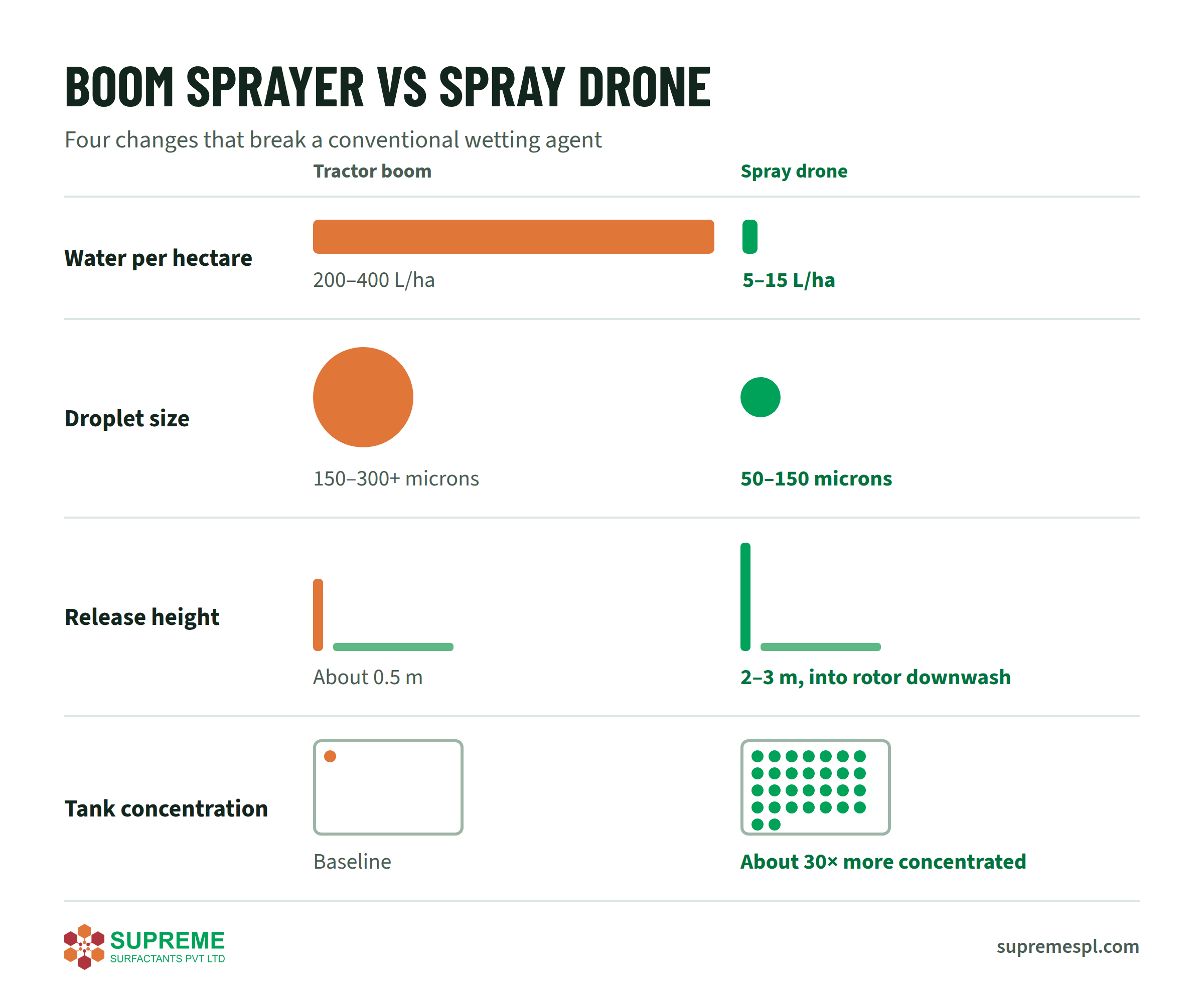
- 13 to 80 times less water. Drones apply 5–15 L/ha instead of 200–400 L/ha.
- Smaller droplets. Typically 50–150 microns. Smaller droplets evaporate faster and drift further.
- A longer fall. Droplets are released 2–3 m above the crop, into turbulent rotor downwash.
- A far stronger tank mix. Actives, nutrients and adjuvants are packed into roughly one thirtieth of the water.
A conventional wetting agent was designed for none of this. It lowers surface tension so large droplets spread on the leaf, but it does little to stop fine droplets drying, drifting, or destabilising a concentrated tank.
What must a drone ready adjuvant do?
A drone ready adjuvant has seven jobs. The best products are systems that handle several of them at once, rather than single function wetting agents.
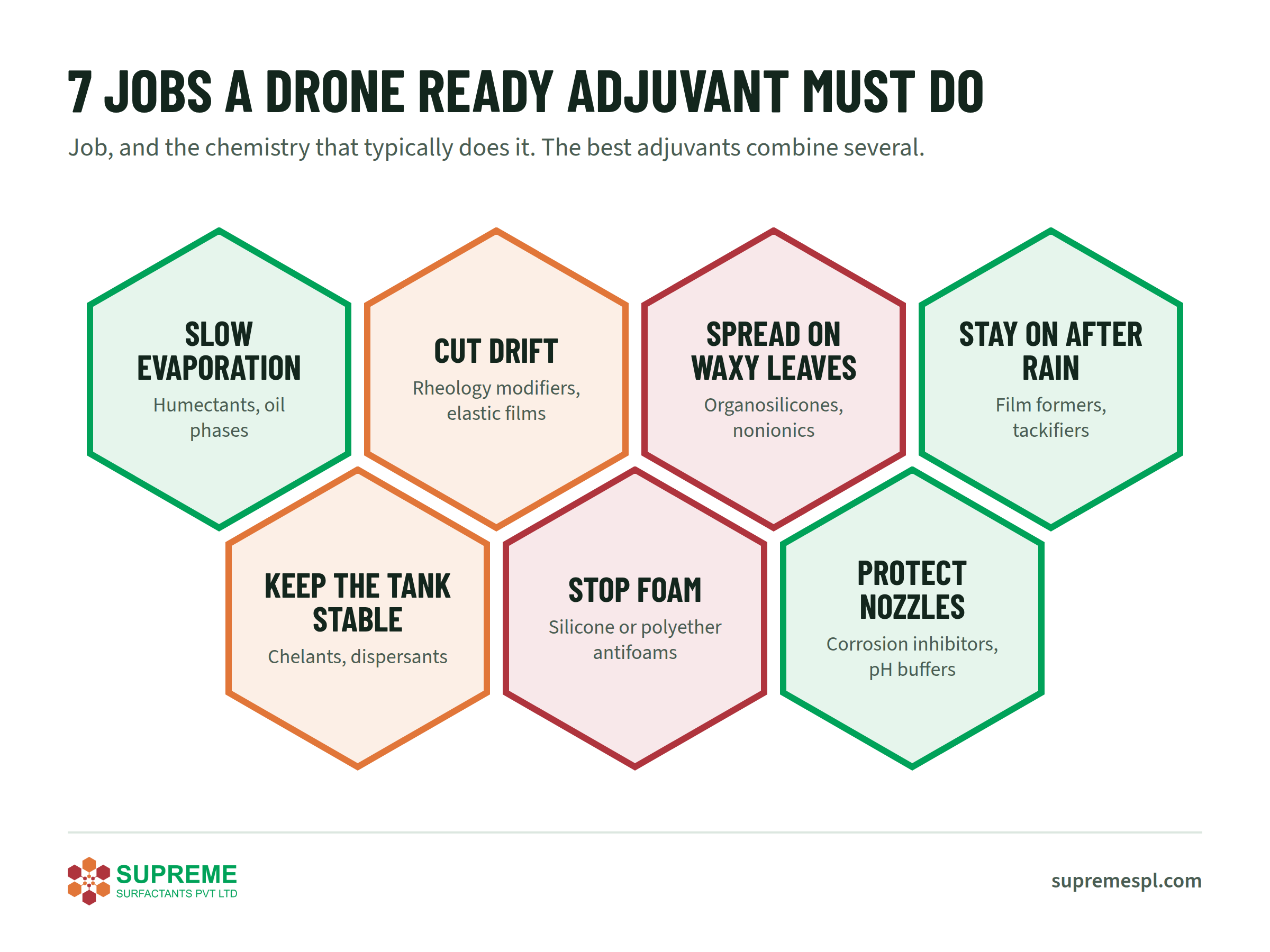
| Job | Typical chemistry |
|---|---|
| Slow evaporation | Humectants, oil phases |
| Cut drift | Rheology modifiers, elastic interfacial films |
| Spread on waxy leaves | Organosilicones, nonionic surfactants (HLB 7–10) |
| Stay on after rain | Film formers, tackifiers |
| Keep the tank mix stable | Chelants, dispersants |
| Stop foam | Silicone or polyether antifoams |
| Protect nozzles | Corrosion inhibitors, pH buffers |
What changed for drone spraying in 2026?
-
 Canada now allows drone application of pesticides registered for aerial use, effective 30 June 2026 (Source: Grainews).
-
 United States — The EPA's Herbicide Strategy is turning drift reduction adjuvants from optional extras into essential mitigation tools (Source: CropLife).
-
 India — Keeping drone use on a pesticide label requires drone-specific data for CIB&RC, and the adjuvant used in those trials shapes the results.
How do you choose a drone adjuvant?
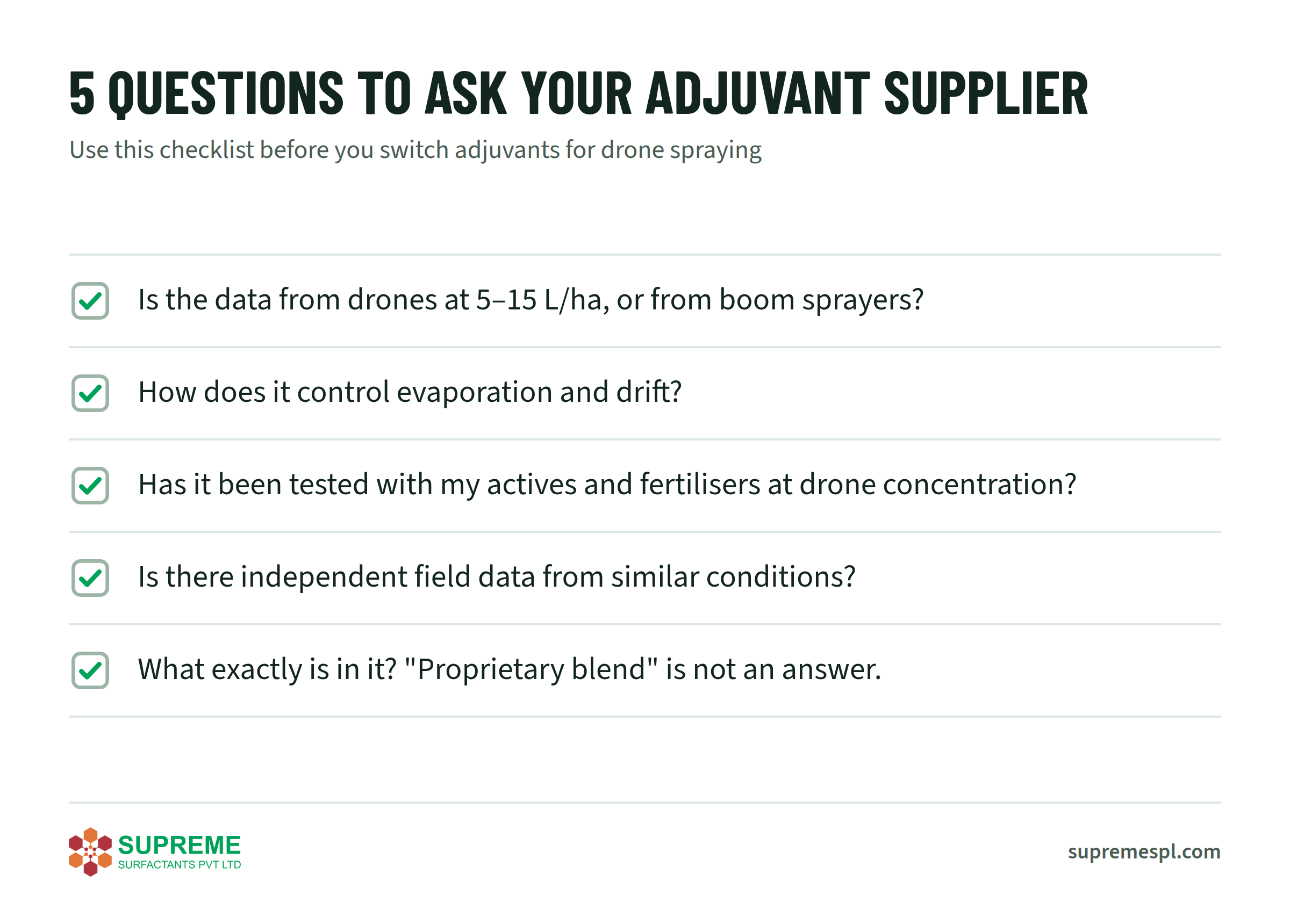
Before switching adjuvants for drone spraying, ask your supplier these five questions.
How Supreme Surfactants helps formulators get drone ready
Supreme Surfactants Private Limited (SSPL) is an Indian manufacturer of specialty surfactants and agrochemical adjuvants, with manufacturing sites in Sonipat, Bharuch and Kathua and an in house R&D team focused on crop protection formulation.
- Tank mix adjuvants from our SUPROL range, plus custom blends for drift control, spreading and retention.
- Formulation surfactants for EC, SC, OD, EW, SE, ME, WDG and ULV systems, so drone performance can be built into the product itself.
- Technical support for compatibility testing with your actives and nutrients at drone concentrations.
Explore our tank mix adjuvants, our R&D capabilities, or read our guide to surfactants for ULV formulations.
Talk to our formulation teamFrequently asked questions
Why is my drone spray not working?
Usually the formulation is the problem, not the drone. Adjuvants designed for high volume boom spraying cannot control evaporation, drift and tank stability at drone volumes of 5–15 L/ha.
What is a drone adjuvant?
A drone adjuvant is a spray additive engineered for ultra low volume aerial application. It combines drift control, evaporation control, deposition and tank mix stability in one system.
How much water does a spray drone use per hectare?
Typically 5–15 litres per hectare, compared with 200–400 L/ha for a tractor boom and 100–150 L/ha for a knapsack sprayer.
Can I use my regular wetting agent in a spray drone?
You can, but expect weaker results. Single function wetting agents do not address the drift, evaporation and concentration problems that drones create.
Where can I buy drone adjuvants in India?
Supreme Surfactants Private Limited supplies tank mix adjuvants and formulation surfactants for crop protection from its manufacturing sites in India. For samples and technical data, contact the team.


